Raising the bar for AI code review in enterprise teams
Most teams adopt AI code review to move faster, then quietly accept more rework. A serious AI code review enterprise workflow has to cut review-to-merge time while keeping the DORA change failure rate flat or trending down. Anything else is just a flashy demo that will age badly in a few days.
That means treating AI as part of your software development system of record, not as a clever web app bolted onto pull requests. You design the workflow so every AI comment, every suggested change, and every policy check has a clear parent signal in your metrics and your incident post mortems. You also define who can add which tools, how they sign off, and how you will view the audit trail when something slips through and you need to find the root cause.
In this context, the phrase AI code review enterprise workflow is not marketing language but a concrete description of how code reviews, tools, and people work together. It spans the moment a developer opens a pull request, the sequence of automated and human review steps, and the post merge monitoring that closes the feedback loop over time. Done well, it turns code review from a blocking ritual into a driven development practice that continuously improves software quality and team flow.
The benchmark that actually matters
For senior engineers and architects, the benchmark is brutally simple. Cycle time for code reviews must go down, while the DORA change failure rate and post merge defect rate stay flat or improve. If your AI code review workflows cannot show that in your own data, they are not ready for long term enterprise use.
GitHub Copilot Enterprise customers who pair AI review with mandatory static analysis and security scanning report around a 30 percent reduction in review cycle time. That reduction only matters because they also track defect density, incident frequency, and the ratio between comment volume and actual review changes merged. Without that discipline, AI generated comments become noise, and reviewers start to sign approvals based on a quick skim rather than a deep view of the code.
Stripe’s public case study on Cursor BugBot showed an 18 percent reduction in pull request rework, which is a very different metric from raw speed. Rework reduction means fewer back and forth comment threads, fewer manually add fixes after the fact, and less wasted time in context switching across days of development. That is the kind of ROI that convinces a skeptical parent organisation that AI in software development is not just another happy Friday experiment.
A four stage AI code review enterprise workflow
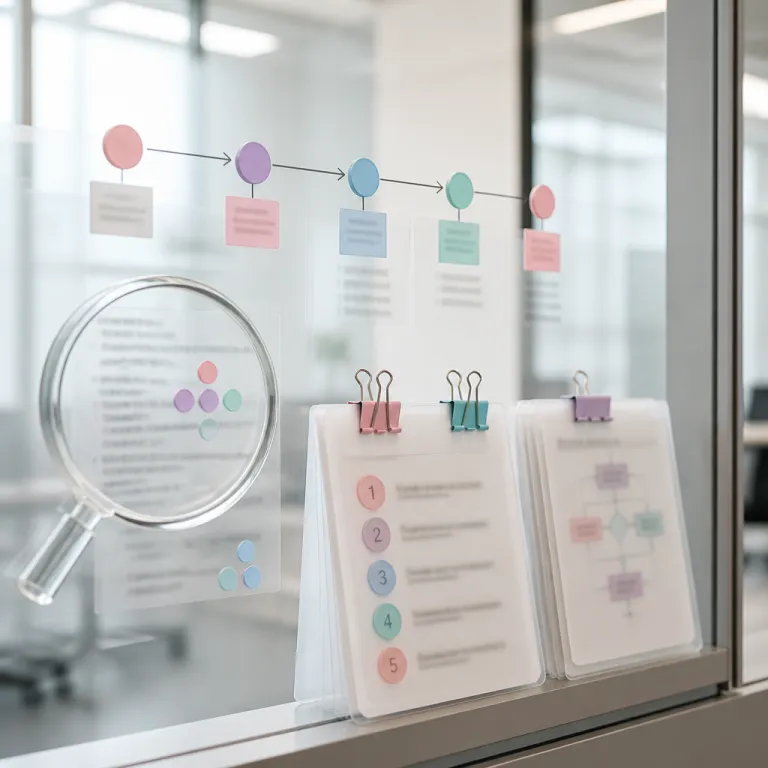
A robust AI code review enterprise workflow has four distinct stages. Each stage uses different tools software and different guardrails, and each stage writes its own signals into your engineering telemetry. The stages are AI pre review on draft, AI second opinion on human review, AI policy enforcement, and AI post merge regression detection.
Stage one starts when a developer opens a draft pull request in your repository and your agent workflows trigger. Tools like GitHub Copilot Workspace, Sourcegraph Cody Reviews, or CodeRabbit run an initial code review that focuses on structural issues, missing tests, and obvious security smells in the code. The AI leaves a first wave of comment threads, and the developer can view and address them before any human reviewer needs to request changes or spend time on low value feedback.
Stage two adds an AI second opinion on top of human review, not instead of it. When a senior engineer leaves a review comment or approves a change, a tool such as Graphite Reviewer or a custom GitHub Copilot based bot can analyse the diff and the discussion to highlight blind spots. This is where natural language understanding matters, because the AI has to read the human review, infer intent from the post discussion, and then suggest specific review changes or extra tests rather than generic advice.
Policy enforcement and post merge feedback
Stage three is AI policy enforcement, where the workflow encodes your organisation’s non negotiables. Instead of relying on humans to remember every security guideline, you configure AI agents and traditional tools to block merges when certain patterns appear in the code. For example, you might require an account sign flow to use a specific authentication library, and the AI will flag any deviation before a reviewer can accidentally sign off.
Here, AI does not replace static analysis or Software Composition Analysis ; it augments them. You still run tools software such as Semgrep, Snyk, or CodeQL, but you also let AI interpret their findings, group related issues by root cause, and comment on the pull request in natural language that developers can act on quickly. The workflow ensures that every automated comment has a clear parent rule, so you can later view which policies generate the most friction and tune them over time.
Stage four closes the loop with AI assisted post merge regression detection. You feed production logs, feature flags, and incident reports into an AI system that can correlate recent deployments, code reviews, and agent workflows to identify where defects escaped. This is where a platform level approach, such as the one described in analyses of agent toolkits for AI driven development, becomes relevant for enterprise scale software development.
Choosing the right tools for each stage of review
Different tools excel at different parts of the AI code review enterprise workflow. GitHub Copilot Workspace is strong at pre review exploration, helping developers understand unfamiliar code and propose refactors before they even open a pull request. Cursor BugBot shines in tight feedback loops on diffs, while Graphite Reviewer focuses on structured code reviews and metrics such as comments per pull request.
Sourcegraph Cody Reviews is particularly effective when your tech stack spans multiple repositories and languages, because it can follow symbols across services and still keep the review grounded in the actual code. CodeRabbit, by contrast, is optimised for in context pull request summaries and targeted suggestions, which can reduce the cognitive load on human reviewers who only have limited time each day. The right mix of tools software depends on whether your bottleneck is understanding legacy code, enforcing policies, or reducing the number of days a pull request sits idle waiting for review.
Whatever you choose, you should benchmark tools against the same metrics. Measure review to merge lead time, the ratio between comment volume and merged review changes, and the post merge defect rate for code reviews that used AI versus those that did not. Then use a detailed comparison of AI coding assistants in real codebases, such as the analysis of Copilot, Cursor, and Claude in production repositories, as a reference point rather than relying on vendor marketing.
How AI fits into existing developer workflows
AI code review should feel like a natural extension of how your équipe already works. Developers should not have to manually add extra steps to their day just to satisfy a new tool. Instead, the AI should attach itself to existing triggers such as pull request creation, comment events, and status checks.
For example, when a developer pushes new commits, the AI can automatically re review changes and update its previous feedback, rather than forcing the developer to request a fresh run. When a reviewer leaves a blocking comment, the AI can suggest concrete code edits that the author can accept or tweak, which makes the tools feel like a pair programmer rather than a compliance bot. Over time, this reduces the friction that often causes people to bypass AI suggestions and revert to old habits.
Authentication and permissions also matter in enterprise workflows. You need clear rules about who can sign approvals, who can view sensitive logs, and how account sign and sign view events are audited across your web app and your source control system. Without that, you risk creating a shadow governance layer where AI agents act on code without a clear parent owner.
Metrics that separate signal from noise
Once AI is in the loop, traditional metrics like lines of code or raw comment counts become misleading. You need to track how AI affects the flow of work, the quality of software, and the behaviour of reviewers. That means defining a small set of metrics that you can explain to both engineers and executives.
Start with review to merge lead time, measured from the moment a pull request is opened until it is merged into the main branch. Break that down by whether AI pre review ran, whether AI second opinion was used, and whether AI policy enforcement blocked the merge at any point in the workflow. Then correlate those slices with incident data, so you can see whether AI assisted code reviews have a different post merge defect rate than traditional reviews over a period of several days or weeks.
Next, look at comment dynamics. Track comments per pull request, but also the comment action ratio, which measures how many comments lead to actual review changes in the code. If AI tools flood your pull requests with low value comments that nobody acts on, your reviewers will tune them out, and your AI code review enterprise workflows will quietly erode trust instead of building it.
Interpreting AI specific review metrics
Graphite’s early data on AI assisted reviews shows that average comment volume per pull request increases when AI is enabled. That is not automatically good or bad ; it depends on whether those comments help developers find the root cause of issues faster or just restate obvious style rules. You need to segment comments by origin, distinguishing between human reviewers, AI agents, and traditional tools.
Then, for each segment, measure how often a comment leads to a code change, a test addition, or a decision to close the pull request without merging. Over time, you will see patterns where certain AI agents consistently produce comments that never lead to action, which is a strong signal to reconfigure or retire those tools. This is how you keep your AI code review enterprise workflow lean, instead of letting it bloat into a maze of overlapping checks.
Finally, connect these metrics to business outcomes. If AI driven development practices reduce the average time to deliver a feature by two days while keeping the change failure rate flat, that is a tangible ROI story. If they only increase the number of comments and the perceived busyness of your équipe, you have work to do on the design of your workflows and the selection of tools software.
Anti patterns that quietly destroy quality
Three anti patterns show up repeatedly when enterprises roll out AI code review at scale. The first is comment inflation, where AI agents generate long lists of minor nits that drown out the few comments that actually matter. The second is fake approvals, where reviewers rely on AI summaries instead of reading the code, and start to sign off on changes they do not fully understand.
The third anti pattern is security check displacement. Teams sometimes disable or relax existing security scanners because they believe AI will catch the same issues in a more developer friendly way. In practice, AI is good at explaining and prioritising findings from tools software, but it is not a replacement for deterministic checks that run on every piece of code.
To avoid these traps, you need explicit policies in your AI code review enterprise workflow. Limit which agents can comment automatically, require that every AI approval suggestion has a human parent reviewer, and never allow AI to override a failing security check. When you see patterns of fake approvals or repeated post merge incidents, treat them as workflow design bugs, not as individual performance issues.
Governance and auditability of AI reviews
Governance is where many AI initiatives stumble, especially in regulated industries. You need a clear answer to the question who reviews the AI’s review, and how that oversight is recorded. That means your workflow must log which AI agents participated in each code review, what they suggested, and which suggestions were accepted or rejected.
In practice, this looks like a structured activity log attached to each pull request. The log should show every AI generated comment, every automated request for changes, and every time a human chose to sign or override a suggestion, with timestamps and identities. When an incident occurs, you can then view the full chain of events and trace the root cause back through both human and AI decisions.
This level of auditability also supports long term learning. By analysing which AI suggestions consistently lead to fewer defects, you can refine your agent workflows and your prompts, and you can decide where to manually add new rules or retire old ones. Over time, your AI code review enterprise workflows become an asset that encodes your organisation’s collective judgment about software development, rather than a black box that nobody fully trusts.
Designing for longevity, not just a flashy rollout
Enterprise leaders often underestimate how quickly AI tools and platforms evolve. A workflow that depends on a single vendor’s web app or proprietary API will age poorly as your tech stack changes. Designing for longevity means decoupling your core review policies from any one copilot or agent implementation.
One practical approach is to define your review policies, quality gates, and metrics in a central configuration that multiple tools can read. Then you can swap out GitHub Copilot, Sourcegraph Cody, or a future platform without rewriting the logic that governs who can sign approvals, when to request human review, and how to handle post merge regressions. This keeps your AI code review enterprise workflow resilient as both your software and your tools evolve over time.
It also means investing in the boring parts of the system. You need reliable logging, consistent identity management for both humans and agents, and a clear mapping between code review events and production incidents. That is the difference between AI as a short lived experiment and AI as a long term capability that shapes how your équipe does driven development across all workflows.
Embedding AI review into the broader delivery system
AI code review does not live in isolation ; it sits inside a broader delivery system that includes planning, deployment, and observability. If your planning process is chaotic, AI will just help you ship the wrong thing faster. If your deployment pipeline is brittle, AI will not save you from frequent rollbacks and late night firefighting.
The most effective teams treat AI code review as one part of a continuous improvement loop. They connect review metrics to deployment frequency, incident rates, and even product level KPIs such as conversion or retention, using analytics approaches similar to those described in analyses of strategic updates and traffic analytics for digital products. This lets them see whether changes in their AI code review enterprise workflows actually move the needle on business outcomes, not just engineering vanity metrics.
Ultimately, the goal is simple. You want a system where developers feel that AI helps them do better work, reviewers trust the signals they see, and leaders can explain how AI affects both risk and ROI. That is what separates a durable AI code review enterprise workflow from yet another tool that everyone will quietly stop using after the first quarter in production, not the keynote demo, but the third quarter in production.
Key statistics on AI code review and enterprise workflows
- GitHub Copilot Enterprise users who pair AI review with mandatory static analysis and security scanning report around a 30 percent reduction in review cycle time, while maintaining stable defect rates in production according to internal benchmarks shared by several large software organisations.
- Stripe’s public case study on Cursor BugBot showed an 18 percent reduction in pull request rework, measured as fewer follow up commits and fewer reopened reviews per change set after deploying the AI reviewer on critical services.
- DORA research on AI assisted teams indicates that productivity gains often come with increased rework, and that net positive outcomes only appear in organisations that enforce disciplined review practices and maintain existing quality gates alongside AI tools.
- Early data from Graphite on AI augmented reviews suggests that average comment volume per pull request increases when AI is enabled, which requires teams to track comment action ratios to ensure that higher volume translates into meaningful review changes rather than noise.
- Enterprise teams that instrument their AI code review workflows with metrics such as review to merge lead time, post merge defect rate, and policy violation frequency report clearer ROI stories and faster iteration on workflow design than teams that only track tool adoption.
FAQ about AI code review enterprise workflows
How should we start designing an AI code review enterprise workflow?
Begin by mapping your current review process end to end, from pull request creation to post merge monitoring. Identify where time is lost, where reviewers repeatedly request the same changes, and where defects most often escape into production. Then introduce AI in one stage at a time, starting with pre review checks, and measure the impact before expanding to policy enforcement or post merge analysis.
Which metrics best show whether AI code review is improving quality?
The most useful metrics combine speed and quality. Track review to merge lead time, post merge defect rate, and the ratio between comment volume and actual code changes made in response to those comments. Compare these metrics for AI assisted code reviews versus traditional reviews over several weeks to see whether AI is delivering real improvements or just more noise.
Can AI replace human reviewers in enterprise software development?
AI should not replace human reviewers for critical changes in enterprise environments. It is effective at catching repetitive issues, suggesting tests, and summarising diffs, but it lacks the contextual judgment needed for architectural decisions, risk trade offs, and domain specific constraints. The most successful teams use AI as a second opinion and a force multiplier, while keeping humans accountable for final approvals.
How do we prevent AI from weakening our security posture?
Never disable existing security scanners or policy checks when you introduce AI. Instead, use AI to interpret and prioritise findings from tools such as static analysis and Software Composition Analysis, and to explain them in natural language that developers can act on quickly. Make sure your workflow treats failing security checks as hard blockers that AI cannot override, and audit how often AI suggestions touch sensitive areas such as authentication or data access.
What governance controls are necessary for AI reviewers in regulated industries?
Regulated organisations need clear governance around AI participation in code review. This includes logging which AI agents contributed to each review, what they suggested, which suggestions were accepted, and who ultimately signed the approval. You should also define policies for where AI is allowed to operate, such as excluding certain repositories or services that handle highly sensitive data, and regularly review these policies as tools and regulations evolve.