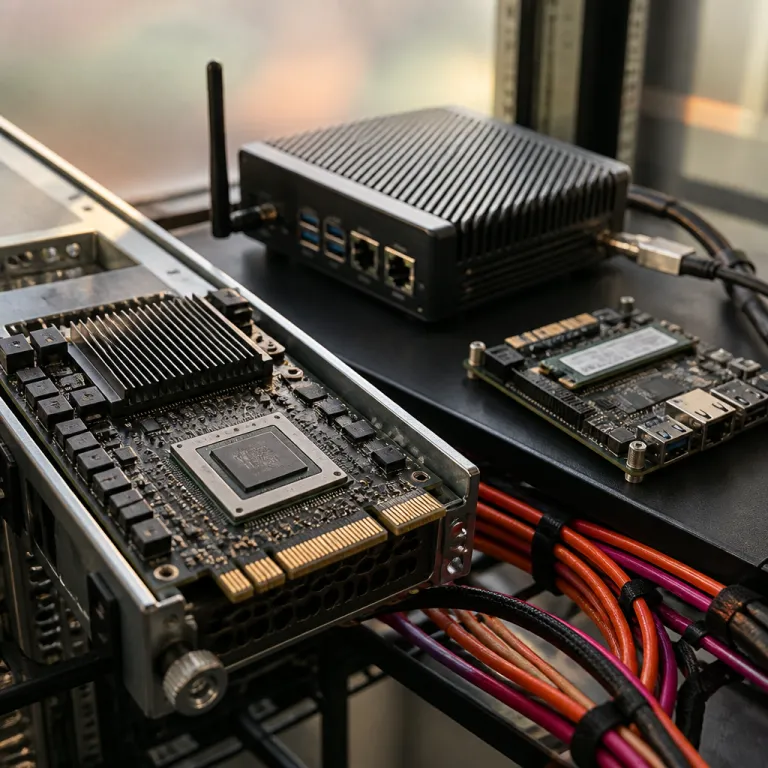
1. From cloud by default to hybrid AI infrastructure on-premises cloud edge
AI inference has turned from an experiment into a core infrastructure bill. As hybrid AI infrastructure on-premises cloud edge architectures spread, software leaders are realising that a pure cloud approach for all workloads quietly erodes margin and constrains design choices. The question is no longer whether to use cloud computing for AI, but where each class of models should actually run.
The Anthropic and TeraWulf multi billion data center lease made one thing obvious. Dedicated AI infrastructure in large data centers is now a strategic asset, not just a hosting detail, and organizations that treat inference as a generic public cloud line item will lose cost leverage. Hybrid infrastructure patterns let you decide which workloads stay in public cloud environments, which move to premises infrastructure, and which shift to edge computing for real time responses.
Architects now juggle latency, data sovereignty, and regulatory compliance in every design. Sensitive data often must remain on premises to satisfy regulatory compliance rules, while bursty experimentation thrives in a flexible public cloud or hybrid cloud setup. The winning architectures treat hybrid AI infrastructure on-premises cloud edge as a portfolio of environments, not a single bet on one cloud solution.
Cost, latency, and sovereignty as first class design variables
Inference volume and latency tolerance now shape infrastructure more than vendor preference. For steady, high volume models, reserved GPU clusters in a private cloud or on premises infrastructure can undercut public cloud services by a large margin over a 12 to 24 month horizon. For spiky or exploratory workloads, public cloud infrastructure and cloud native services still shine.
Data classification and jurisdiction add another layer of complexity. Personally identifiable data or health records often cannot leave specific data centers or a national data center region, which makes a hybrid cloud and private public mix unavoidable for serious organizations. Hybrid AI infrastructure on-premises cloud edge therefore becomes the only way to align compliance, performance, and business economics.
Operational capability is the last hard constraint. Running GPU heavy systems on premises demands strong management practices, from capacity planning to hardware lifecycle management, while relying only on cloud services can hide risks in opaque pricing and egress fees. Mature teams treat each environment as part of a single infrastructure strategy, with shared observability, deployment pipelines, and governance.
2. Three placement patterns for AI models across cloud, premises, and edge
Across sectors, three patterns for AI model placement are emerging. First, public cloud environments handle experimentation, rapid prototyping, and low volume workloads where flexibility beats raw cost, especially when teams lean on managed cloud services and cloud native tooling. Second, on premises or private clouds host predictable, high volume inference where infrastructure amortisation and energy efficiency matter most.
Third, edge computing nodes close to users or devices serve ultra low latency applications. Think of industrial inspection cameras, retail kiosks, or smart locker software that must respond in real time without a round trip to a distant data center. In these cases, hybrid AI infrastructure on-premises cloud edge designs push compact models to the edge while keeping heavier training workloads in a central data center or public cloud.
For many organizations, the hardest part is not the technology but the data foundation. Without clean, well governed data in both cloud environments and premises infrastructure, AI agent deployments stall before production, as detailed in this analysis on the data foundation gap for enterprise AI. Hybrid infrastructure only pays off when data management, lineage, and access controls are consistent across systems.
Mapping workloads to the right environments
Start by classifying workloads into three buckets. Latency sensitive applications such as fraud detection, personalised recommendations, or industrial control often benefit from edge deployment, with models running on local systems and synchronising with cloud infrastructure asynchronously. High volume, stable inference for internal business processes usually belongs in a private cloud or on premises data centers where you control hardware and energy contracts.
Meanwhile, exploratory or seasonal workloads fit naturally in public cloud or hybrid cloud setups. Here, cloud solutions from providers such as Google Cloud, Microsoft Azure, or Amazon Web Services offer elastic GPU capacity and rich cloud services for monitoring, logging, and deployment. The art is to avoid leaving mature, predictable workloads stranded in expensive public cloud environments when they deserve a more efficient premises infrastructure.
Each placement decision should be backed by a simple report style model. Estimate total cost of ownership for 12 to 24 months, including hardware, cloud computing fees, egress, personnel, and energy, then compare private cloud, public cloud, and edge options. Over time, this discipline turns hybrid AI infrastructure on-premises cloud edge from an ad hoc pattern into a repeatable infrastructure playbook.
3. Regulatory compliance and AI governance reshape infrastructure choices
Regulators are no longer impressed by generic claims about cloud security. Data protection laws and AI specific rules in regions such as the European Union now demand concrete evidence of where data lives, how models are trained, and how inference is monitored across all environments. That pressure makes hybrid infrastructure and premises infrastructure more attractive for sensitive workloads.
When data cannot leave a jurisdiction, public cloud alone is rarely enough. Even when a public cloud provider offers regional data centers, organizations often prefer a private cloud or on premises data center to maintain tighter control over systems and deployment pipelines. Hybrid AI infrastructure on-premises cloud edge lets teams keep sensitive data and models local while still using cloud solutions for less regulated workloads.
Boards are also asking sharper questions about AI governance. They want to know how model management, access control, and incident response work across hybrid cloud, private clouds, and edge devices, not just in a single cloud environment. A practical overview of these concerns appears in this piece on agentic AI governance and board level controls, which highlights why governance must span every infrastructure layer.
Designing for auditability across cloud and premises
To satisfy regulatory compliance, you need traceability across the full AI lifecycle. That means logging which models run where, which data they consume, and how outputs are used in business applications, whether those applications live in public cloud environments, private clouds, or edge systems. Without this, even a well designed hybrid cloud architecture can fail an audit.
Architects should standardise observability and policy enforcement across all infrastructure. Use consistent identity and access management, encryption, and key management across cloud infrastructure, premises infrastructure, and edge computing nodes, so that compliance teams see one coherent control surface. This reduces the risk that a forgotten edge deployment or shadow public cloud instance becomes a compliance liability.
Finally, governance must be baked into deployment workflows. Treat every new AI workload as a change that passes through policy checks, security review, and data classification, regardless of whether it targets a public cloud, a private cloud, or an on premises cluster. Hybrid AI infrastructure on-premises cloud edge only earns trust when governance is as distributed as the systems themselves.
4. Modelling total cost of ownership for AI inference
Sticker prices for cloud computing can be seductive. Per token or per hour GPU pricing in public cloud services looks cheap for a single experiment, but it becomes punishing when a model turns into a core business dependency. The only rational way to choose between cloud infrastructure and premises infrastructure is to model total cost of ownership over time.
For predictable, high volume inference, reserved GPU clusters in a private cloud or on premises data centers often win. When you factor in hardware depreciation over three to five years, energy contracts, and efficient cooling, the effective per token cost can drop well below public cloud rates, especially once egress and premium cloud services are included. Hybrid infrastructure lets you keep bursty workloads in public cloud environments while shifting the heavy, steady workloads to cheaper systems.
Cost models must also account for people and process. Running your own infrastructure demands skilled teams for capacity management, deployment automation, and incident response, while relying on a public cloud or hybrid cloud setup shifts some of that work to the provider but introduces new vendor management overhead. The right balance depends on your existing data centers, your appetite for capital expenditure, and your long term AI roadmap.
Practical steps to build a credible cost model
Start by collecting a month of detailed usage data for your AI workloads. Break down which models run where, how many tokens or inferences they consume, and which applications depend on them in real time. Then project those workloads forward under realistic growth scenarios, rather than assuming flat usage.
Next, build side by side scenarios for public cloud, private cloud, and hybrid AI infrastructure on-premises cloud edge. Include hardware purchase or lease costs, cloud services fees, storage, networking, and the cost of operating data centers or edge systems, then normalise everything to a cost per million inferences. This makes it easier to compare a cloud solution from Google Cloud with an on premises deployment in your own data center.
Finally, revisit the model quarterly. As models, workloads, and business priorities evolve, the optimal mix of cloud environments, private clouds, and edge computing will shift, and so will the economics. Treat the report as a living artefact that guides infrastructure strategy, not a one off justification for a single deployment decision.
5. Designing the control plane for hybrid AI infrastructure on-premises cloud edge
Once you accept that AI inference will run across cloud, premises, and edge, the control plane becomes the real product. Teams need a unified way to deploy, monitor, and roll back models across heterogeneous environments, without turning every release into a bespoke project. This is where cloud native patterns and platform engineering pay off.
Modern platforms expose AI inference as a service, abstracting away whether a given call hits a public cloud endpoint, a private cloud cluster, or an edge device. Under the hood, they use Kubernetes, service meshes, and GitOps style deployment pipelines to orchestrate workloads across data centers and cloud environments. The goal is to make hybrid infrastructure feel like one logical system, even though it spans multiple physical locations.
Strong management practices are essential here. Centralised logging, metrics, and tracing let teams compare performance and reliability across public cloud, private clouds, and on premises systems, while policy engines enforce where certain classes of data or models are allowed to run. Without this, hybrid AI infrastructure on-premises cloud edge degenerates into a fragile collection of one off deployments.
Patterns that keep complexity under control
Several patterns help keep complexity manageable. First, standardise on a small set of deployment templates for different workload types, such as low latency edge inference, batch processing in a data center, or interactive APIs in a public cloud. Each template should encode best practices for scaling, resilience, and compliance.
Second, treat every environment as a peer. Avoid building special snowflake processes for premises infrastructure while leaving cloud environments fully automated, because that asymmetry will slow down the very workloads that most need speed. Instead, aim for a single platform that can target cloud infrastructure, private clouds, and edge systems with the same tooling.
Third, invest in clear ownership boundaries. Define which teams own the shared platform, which own specific applications, and how incident response works when a failure spans public cloud and on premises data centers. The more explicit these contracts, the easier it becomes to evolve your hybrid cloud and private public mix without paralysing delivery.
6. What software leaders should do in the next 12 to 24 months
For senior software architects and tech leads, the next planning cycle is pivotal. Hybrid AI infrastructure on-premises cloud edge is no longer a speculative pattern, it is the default for organisations that expect AI to sit in the critical path of revenue. The leaders who move now will lock in better economics and stronger control than those who wait for a perfect blueprint.
First, map your current AI workloads and infrastructure footprint. Identify which models run in public cloud environments, which rely on existing data centers, and which could benefit from edge computing for real time responses, then classify them by business criticality and regulatory sensitivity. This inventory becomes the backbone of your infrastructure strategy and your next investment report to executives.
Second, run targeted pilots rather than grand rewrites. Move one high volume workload from a public cloud to a private cloud or on premises cluster, and push one latency sensitive application closer to the edge, then measure cost, latency, and reliability with discipline. Use these results to refine your hybrid infrastructure roadmap and to challenge vendor narratives that promise effortless cloud solutions without trade offs.
Building durable advantage, not just cutting costs
Cost savings are only part of the story. A well designed mix of cloud infrastructure, premises infrastructure, and edge systems also improves resilience, reduces vendor lock in, and opens new product possibilities that pure public cloud deployments cannot match. For example, combining edge inference with secure storage software, as discussed in this piece on smart locker platforms and secure storage, enables new real time services that depend on local decision making.
Over time, your infrastructure strategy will shape your ability to ship differentiated applications. Organizations that treat hybrid cloud and private public choices as a strategic design space, rather than a procurement detail, will be better positioned to adapt as models, regulations, and hardware evolve. The real test of your hybrid AI infrastructure on-premises cloud edge is not the keynote demo, but the third quarter in production.
Key statistics on hybrid AI inference and infrastructure
- According to a recent industry analysis by McKinsey, AI and analytics workloads already account for more than 25 percent of total cloud computing spend for large enterprises, highlighting why inference placement has become a board level infrastructure decision.
- Research from the Uptime Institute reports that over 60 percent of organisations now operate in hybrid cloud environments that combine public cloud, private cloud, and on premises data centers, reflecting the shift away from a single cloud approach.
- A study by the International Energy Agency estimates that data centers consume around 1 to 1.5 percent of global electricity use, which makes energy efficient premises infrastructure and edge computing a material factor in long term AI cost models.
- Gartner forecasts that by the middle of the decade, more than 50 percent of enterprise generated data will be created and processed outside traditional data centers or public cloud environments, underscoring the rise of edge systems in AI architectures.
FAQ
How do I decide whether to run AI inference in the cloud or on premises?
Start by analysing inference volume, latency requirements, and data sensitivity. High volume, predictable workloads with strict data residency constraints often fit better in a private cloud or on premises data center, while low volume or experimental workloads benefit from the elasticity of public cloud services. A hybrid AI infrastructure on-premises cloud edge approach lets you mix these options based on concrete cost and compliance data.
When does edge computing make sense for AI workloads?
Edge computing is most valuable when applications need real time responses or must operate reliably with limited connectivity to a central data center. Examples include industrial control systems, retail checkout, and IoT devices that cannot tolerate network latency to a distant public cloud region. In these cases, running compact models on edge systems while synchronising with cloud infrastructure in the background offers the best balance.
Is a hybrid cloud strategy more expensive than using a single public cloud?
A well designed hybrid cloud strategy is not inherently more expensive and can be significantly cheaper for steady, high volume inference. While there are added management and integration costs, shifting suitable workloads to private clouds or on premises infrastructure often reduces long term spend compared with keeping everything in a public cloud. The key is to model total cost of ownership, including people, energy, and networking, rather than focusing only on headline cloud pricing.
How does regulatory compliance affect AI infrastructure choices?
Regulatory compliance often dictates where data can be stored and processed, which directly influences infrastructure design. Sensitive or regulated data may need to stay in specific jurisdictions or within premises infrastructure, pushing organisations toward private cloud or on premises deployments for certain workloads. Hybrid AI infrastructure on-premises cloud edge allows teams to meet these requirements while still using public cloud environments for less sensitive applications.
What skills does my team need to operate hybrid AI infrastructure effectively?
Operating hybrid AI infrastructure requires a blend of cloud engineering, on premises systems management, and platform engineering skills. Teams need expertise in Kubernetes or similar orchestration tools, observability, security, and deployment automation across both cloud environments and data centers. Investing in these capabilities turns hybrid infrastructure from a source of complexity into a durable competitive advantage.